
Summarised below are some of the projects in which Hyphen-21 has been involved over the years. The majority come under the heading of mental health social work.
Poems for…the wall
This project offers poems for display in healthcare waiting rooms, libraries, class-rooms and other settings. The project has been funded by the Arts Council of England, the Poetry Society, the King’s Fund, NHS Estates, the Dept of Health Equality and Human Rights Group, the Baring Foundation, the Foreign Office and the John Lewis Partnership. Many of the poems are bilingual, in celebration of connection through diversity. The poem collections are on display in sites all over the UK and indeed the world. Since 2008, when the project went digital, people have downloaded them in large numbers from the project’s website – https://poemsforthewall.org Most of the downloads come from school-teachers, but also librarians and healthcare professionals.
In 2019, a significant number of the poems were enlarged, printed onto a foamex paperboard material and exhibited in Clifton (Roman Catholic) Cathedral. Some striking photographs of the exhibition can be found here. The pictures convey well both the quality of the poems available, and their power.
Mental Health Ward Round Code of Professional Conduct
Ward rounds can be deeply intimidating. The experience can be especially traumatic for people with mental health problems. The code referred to here took years to put together. It was devised with the classic mental health ward round in mind, which could (and still can ?) involve up to a dozen mental health professionals surrounding a single disturbed person in a room. The code sets out guidelines for how to make the ward round and similar meetings more sensitive and respectful. It was implemented in at least one North London NHS mental health Trust, though how consistently and effectively was always open to question. The code was published in the magazine Openmind and presented to the all-party parliamentary group for mental health in Portcullis House, winning the group’s support ; it was later recognised as good practice by the Department of Health and by the National Institute for Mental Health in England (NIMHE). Here is a copy of the code. Here is a copy of a leaflet we composed for handing out to hospital patients.
Consulting with the Users of Mental Health Care Services
For years now, all care organisations have been required to consult with the users of their services at every level. But how to do this in a way that is both real, skillful, respectful and constructive ? How can a rushed and over-stretched manager consult with due care ? How competently a service “consults” with the people it serves is, in many ways, a measure of how competent a service is. The subject is complex and worthy of close attention. Here is a brief article on the subject published years ago in “Openmind.”
Service User Involvement in Staff Recruitment
Involvement in staff recruitment is a valid and effective way for service users to influence service quality. The model proposed by Hyphen-21 involves a separate user panel and assesses senior staff on their relationship skills, in the here and now, as directly experienced and observed in the interview. These would later be measured against guidelines and indicators that have emerged from the Rogerian school of psychotherapy. The approach was commended by the Commission for Health Improvement and an article describing the model was published by the magazine “OpenMind.” Here is a short working paper describing the model in more detail. The paper was used as the basis for introducing this approach to Westminster’s mental health services some years ago.
Morale in Care Organisations
Morale in care services is a central issue, of course. “Care” cannot be turned on like a tap. Nor will it flourish if care workers are treated by their managers just as mechanical instruments or by Society as convenient scapegoats for every painful event that happens. Hyphen-21 produced a paper on this subject over 20 years ago. The paper was supported in principle by Dr Peter Carter, later to become Chief Executive of the Royal College of Nursing. The paper will be reviewed and revised over time. Here is the present version.
Shared Care Recording
The Shared Care Record (or “Home Support Book”, or “Patient-Held Record” ) offers the patient custody and control of his/her own health record. Rogan Wolf piloted a mental health version in the mid 1990’s and a year or so later a version for house-bound older people in Kensington. This last initiative took place under the management and co-ordination of Peter Smith, on behalf of Kensington and Chelsea Social Services. Articles describing the approaches were published in OpenMind and in the Nursing Times magazines. We believe the general concept can be valuable in the support of people with learning difficulties as well. It gives clients a sense of ownership and involvement in their care and progress. Their record becomes less “your file on me,” than “my story, with your help.” Various examples of the approach have since gone into circulation, but its success or failure would seem to depend less on file design than on available worker time and worker morale and on the relationsjip between worker and client. Computerised recording is not a substitute for this approach, nor does it address many of the important issues raised by recording in general.
Spirituality and Mental Health
Spirituality can be a creative and helpful topic in mental health circles. It offers a different and more normal imagery, often rich. We offer a good paper that explores the subject with profundity and poetry. The writer, Julie Liebrich, gave her permission for Hyphen-21 to publish her paper, presented originally at a World Federation for Mental Health conference. Here it is.
Poetry Workshops for Carers
Creative writing workshops for family members and Carers has been found to be helpful both for mutual support and for expression. The writing in silent company, followed by reading out to fellow group-members, can both facilitate expression of strong feelings and provide a form of containment for them. Some years ago, a series of these poetry workshops for carers was conducted in Westminster. It was funded by the King’s Fund and resulted in several poetry readings.
Poem “A Light Summer Dying” by Rogan Wolf
This is a long poem which tells the true story of a death from cancer, not just the way the person at the centre of the experience lived it through, but how her family and community lived it with her. The poem was well received by a significant number of people, including the poets Andrew Motion and Moniza Alvi, but also by priests and hospice workers. It has been recited to good effect to Macmillan nurses in training and to social work students on a university course. Due to its subject matter, it is of course not an easy poem to read or to listen to, though readers tend to agree that it is somehow – perhaps strangely – uplifting. It can be found on the right of the home page of Rogan Wolf’s blog at https://roganwolf.com . Click here for comments it has received.
‘Augustin’ by the late Mary Young
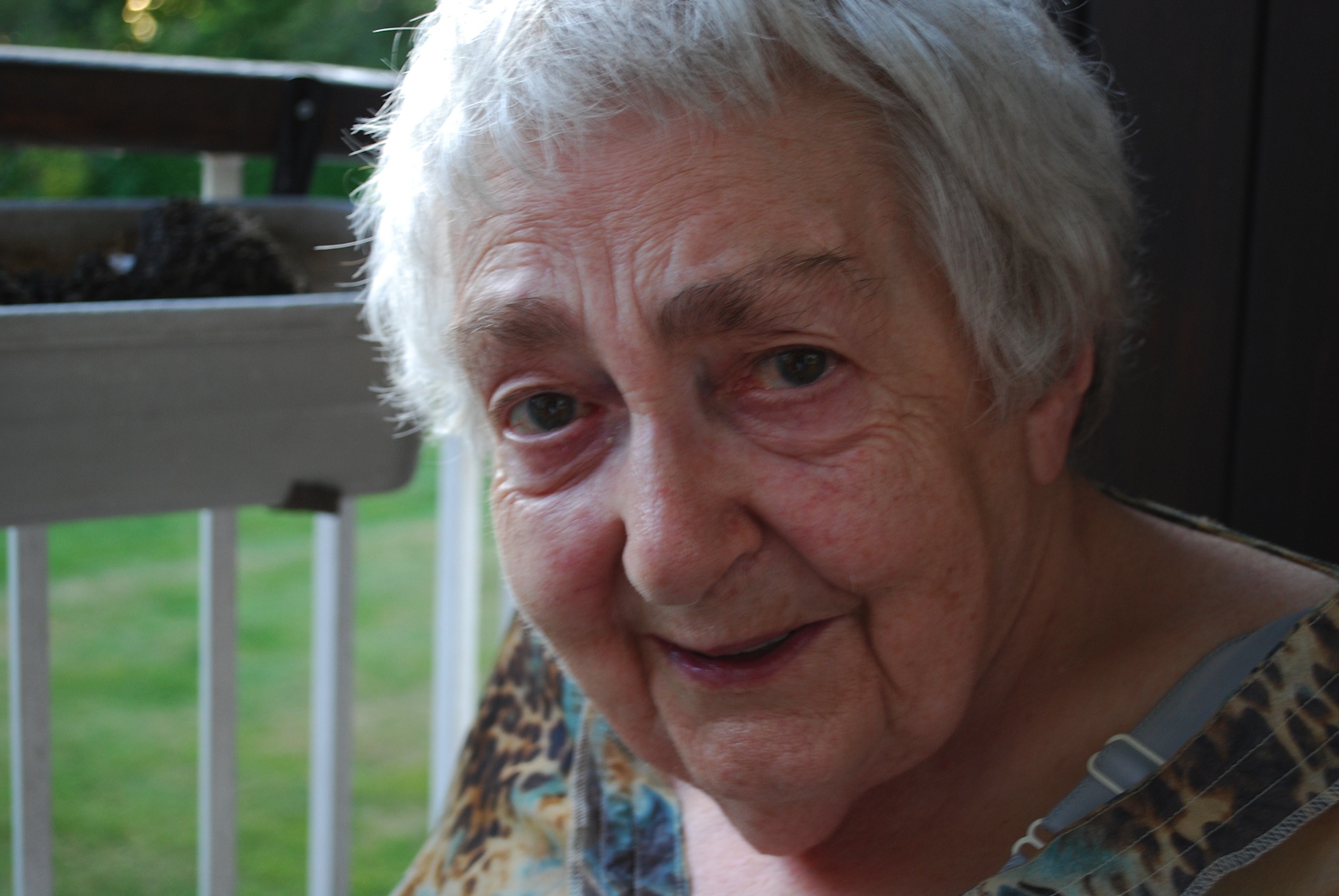
This final item is not a ‘Hyphen project’ as such. Instead, it provides a link to a significant piece of work by Mary Young, (see above). Mary was a Trustee of this charity, until she died in 2012. She was both a psychotherapist and a historian. In this latter ‘identity’, she became fascinated by the French Revolution and – in particular and perhaps mysteriously – by the role played in it by Augustin Robespierre. Augustin was the younger brother of the famous/notorious Maximilien Robespierre. He was more moderate than Maximilien, but also astonishingly loyal to him. He played a much lesser role in the French Revolution, but when the end came, and Maximilien was taken to be guillotined, Augustin insisted on being executed with him, an entirely voluntary, unnecessary act. It was this last that drew Mary to him, perhaps trying to understand. She undertook her own extensive research, possibly unique, and wrote a small, beautifully written book on the subject. Just months before she died, her friends came together to arrange for its publication and Dr. Marisa Linton, Reader in History at Kingston University, wrote its preface. Marisa is a specialist in the French Revolution. Thanks are also due to Mevlut Ceylan and to Graham Thorp for their important contributions to this initiative. Here is a link to the pdf copy of Mary Young’s, ‘Augustin’.